Antarctic Station Worker (Trades)
Antarctica is the coldest, driest, windiest place on Earth, and someone has to keep the lights on down there. You would be one of roughly 1,000 people on the entire continent during winter, doing trades work that keeps a research station alive in conditions that will kill you if the equipment fails. Most people will never see what you see. Almost none of them will be able to explain what it actually feels like.
You are going to McMurdo Station, Palmer Station, or the Amundsen-Scott South Pole Station, depending on your specialty. These are not rustic camps. They are functional industrial facilities with power plants, water treatment, heavy equipment, and communication systems that have to run 24 hours a day in temperatures that can drop below minus 100 degrees Fahrenheit with wind chill. Your job is to keep that infrastructure working. The work itself is familiar if you have a trades background. Plumbing, HVAC, electrical, heavy equipment operation, carpentry, vehicle mechanics. What is not familiar is the environment. The cold affects everything. Metal becomes brittle. Seals crack. Fuel thickens. You are troubleshooting problems that do not exist anywhere else, with parts that may take weeks to arrive if they can arrive at all. You learn to improvise and you learn fast. You will be deployed for four to fourteen months depending on the contract and the season. Summer deployments run roughly October through February. Winter-over contracts keep you on the ice through the polar night, when there are no flights in or out and the crew shrinks to around 150 people. The isolation is real. So is the bond you build with the people around you.
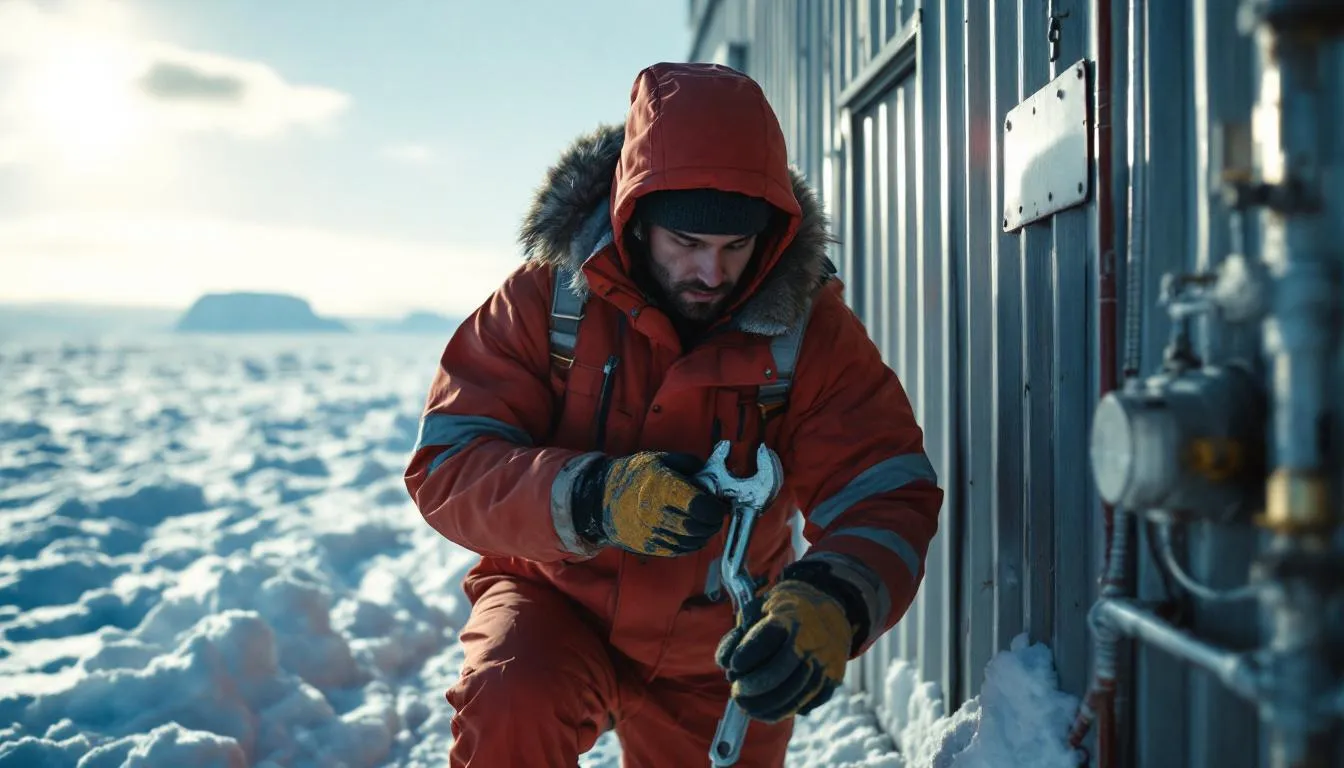
Your actual daily work depends on your trade. A heavy equipment operator is moving snow, clearing runways on the sea ice, and hauling fuel and cargo between facilities. An HVAC tech is maintaining heating and ventilation systems in buildings where a failure is not an inconvenience but an emergency. An electrician is keeping the power plant running, troubleshooting distribution issues, and making sure backup systems are tested and ready. A plumber is managing freeze protection on water lines, maintaining the water treatment plant, and handling the kind of emergency repairs that get called in at 3 a.m. during a storm. Beyond your specific specialty, everyone does preventive maintenance on a schedule. You are logging work orders, inspecting equipment before and after use, and keeping documentation that the program depends on. When something breaks that does not fall neatly into your job title, you figure it out anyway, because calling a different contractor is not an option. The unusual part of the job is harder to describe. You might be the person who has to suit up in extreme cold weather gear to go fix a generator in a remote field camp. You might be operating a forklift on sea ice with open water visible nearby. You might spend three days working on a problem because the manual does not account for what happens to a component at minus 60. These are the moments people talk about for the rest of their lives.
People who do well here are comfortable being self-sufficient for long stretches and do not need a lot of outside stimulation to stay even-keeled. You are also living in close quarters with the same 150 to 1,000 people for months, so someone who is generally easy to get along with without being fragile holds up better than someone who either isolates completely or causes friction. The people who come back season after season tend to be genuinely good at their trade and curious enough about the environment that the novelty does not wear off after week two.
The Antarctic stations are operated under contract to the National Science Foundation. The primary contractor handling operations and trades staffing is Leidos (formerly Lockheed Martin, formerly Raytheon Polar Services). You apply directly through Leidos for open trades positions. Search 'Leidos Antarctica' or 'USAP jobs' and look for your trade. You need a journeyman-level background or equivalent experience in your trade. Plumbers, electricians, HVAC techs, heavy equipment operators, carpenters, and vehicle mechanics are the most common hires. A union card helps. Actual certifications in your trade help more. They want to know you can work unsupervised and solve problems without calling for backup, because backup is not coming. You also have to pass a physical and psychological evaluation. They are not looking for anything extreme, but they want to know your body and mind can handle prolonged isolation and physical stress. Some people wash out here who have no problem with the technical work. From application to ice, expect a process that takes several months. The program runs on a seasonal cycle. If you are targeting a summer deployment, start applying in spring. Winter-over positions are harder to get and usually go to people who have done at least one summer season first. Once you get one contract, getting the next one is much easier.
The isolation is not a joke. Winter-over means months of polar darkness, no flights in, and no way to leave if something goes wrong in your personal life back home. Relationships suffer. Some people find they handle it fine. Others discover mid-deployment that they do not, and there is not much to do about it at that point. The psychological screening exists for a reason, but it does not catch everything. The physical toll is also real in ways that are easy to underestimate. The dry air wrecks your skin and sinuses. Working in extreme cold for extended periods is hard on joints and extremities. Frostbite is a genuine risk, not a theoretical one. And the pace of operations can be relentless during summer season when the program is running full speed. You will be tired in a way that feels different from regular job tired, and then you will do it again the next day.